
Ian Dobbs
Head of Wholesale & Carbon Markets Expert, Tasman Environmental Markets
Ian brings more than 25 years of trading and risk-management experience across financial markets in the UK, South Africa and New Zealand — from running bank trading books in bonds, rates and currencies to trading futures on the London International Financial Futures and Options Exchange and co-founding a derivatives trading firm. Having navigated the Asian Currency Crisis, the Dot-com bubble and the Global Financial Crisis, Ian now applies that hard-won market insight to carbon, leading TEM's wholesale trading desk and providing clients with a front-row view of the forces shaping global carbon markets. Read more about Ian.
Australian Carbon Credit Units - Premium Methodologies
Will Australian Carbon Credit Units Methodology Spreads Narrow? A Long-Term Market Outlook
The “Generic” ACCU market, currently trading around $37.90, accounts for the vast majority of liquidity and trading. That’s unsurprising, given it’s where most Safeguard entities source their ACCUs for compliance purposes. About 10 cents higher, HIR (Human Induced Regeneration) ACCUs have traded for much of the past year. Above that sits a range of other methodologies currently priced up toward $60, and sometimes higher still. This article focuses on the long-term outlook for these “premium” ACCUs, which generally trade at a spread of $15-$20 above generics.
These premium ACCUs include, but are not limited to, methodologies such as Indigenous Savanna Burning, Environmental Plantings, some boutique Plantation Forestry, and even some Soil Carbon credits have been offered around this price point. While generation cost is a factor in the high price of some methodologies, scarcity and solid historical demand from voluntary buyers have also played a major role. It’s these last two factors that now point to a very different picture for the premium these ACCUs are likely to command over the coming years.
The voluntary market today is clearly not where it was two or three years ago. Constant media scrutiny of carbon project methodologies, combined with growing concern over greenwashing claims, has prompted many corporates to rethink their sustainability policies, resulting in a contraction in voluntary buyers. The Australian government’s recent announcement about the end of Climate Active certification is a further blow to the voluntary sector. The implication for the demand side of the equation, in relation to premium ACCU’s, is clear. Unfortunately, this declining demand will be magnified by a significant increase in supply over the next few years. As a result, methodology spreads currently trading in the $15-$20 range above generic ACCUs could easily fall to $5-$10, or lower.
Take Environmental Plantings as an example. As at Q1 2026, 310 EP projects were registered in total, of which 255 (82%) were registered between 2022 and 2025.
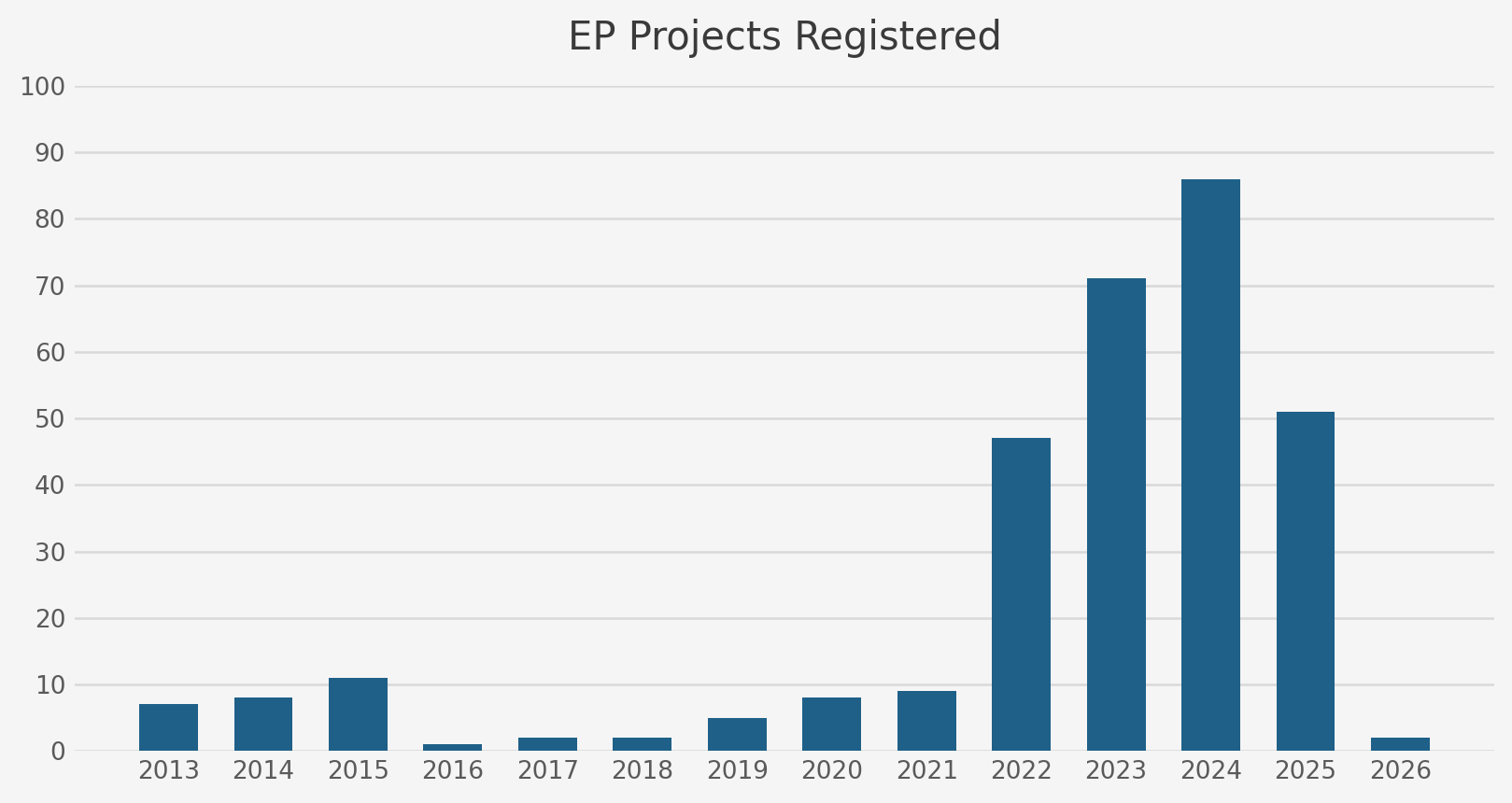
Given the long lead time between registration and first issuance for EP projects, most of these will only start issuing credits over the next 6-24 months. We’re only now starting to see projects registered early in that window begin issuing credits, and volumes will ramp up significantly over the next couple of years. That increased supply, combined with declining voluntary demand, will force a significant contraction in the premium these ACCUs trade at. To be clear, this doesn’t necessarily mean a fall in the outright price of EP or other methodologies affected by the same trends, it’s equally possible these continue trading in the $50-$60 range while the underlying generic ACCU price “catches up,” rallying toward $50 by 2029 on compliance buying. Either way, the premium spread is likely to compress to well under $10.
We’ve seen this play out before with HIR. There was a time when HIR commanded a $5.00 premium over generic ACCUs in the wholesale market, driven by voluntary demand. Today it trades flat, or at best a 10-cent premium. That compression was driven by declining voluntary demand following negative press coverage of the methodology.
Very few compliance buyers in the Safeguard system are willing to pay for higher-quality ACCUs than they need. As the only real support for premium-priced methodologies comes from voluntary buyers, declining voluntary demand combined with rising premium ACCU supply over the next 1-3 years will likely see all methodologies trade in a much tighter band relative to each other.
This information has been prepared by Tasman Environmental Markets Australia Pty Ltd (TEM), a corporate authorised representative (ABN 97 659 245 011, CAR 001297708) of TEM Financial Services Pty Limited (ABN 58 142 268 479, AFSL 430036). This material is for general information only and is not intended to provide you with financial advice or take into account your objectives, financial situation, or needs.